CLaSH programs in Education and Workforce development
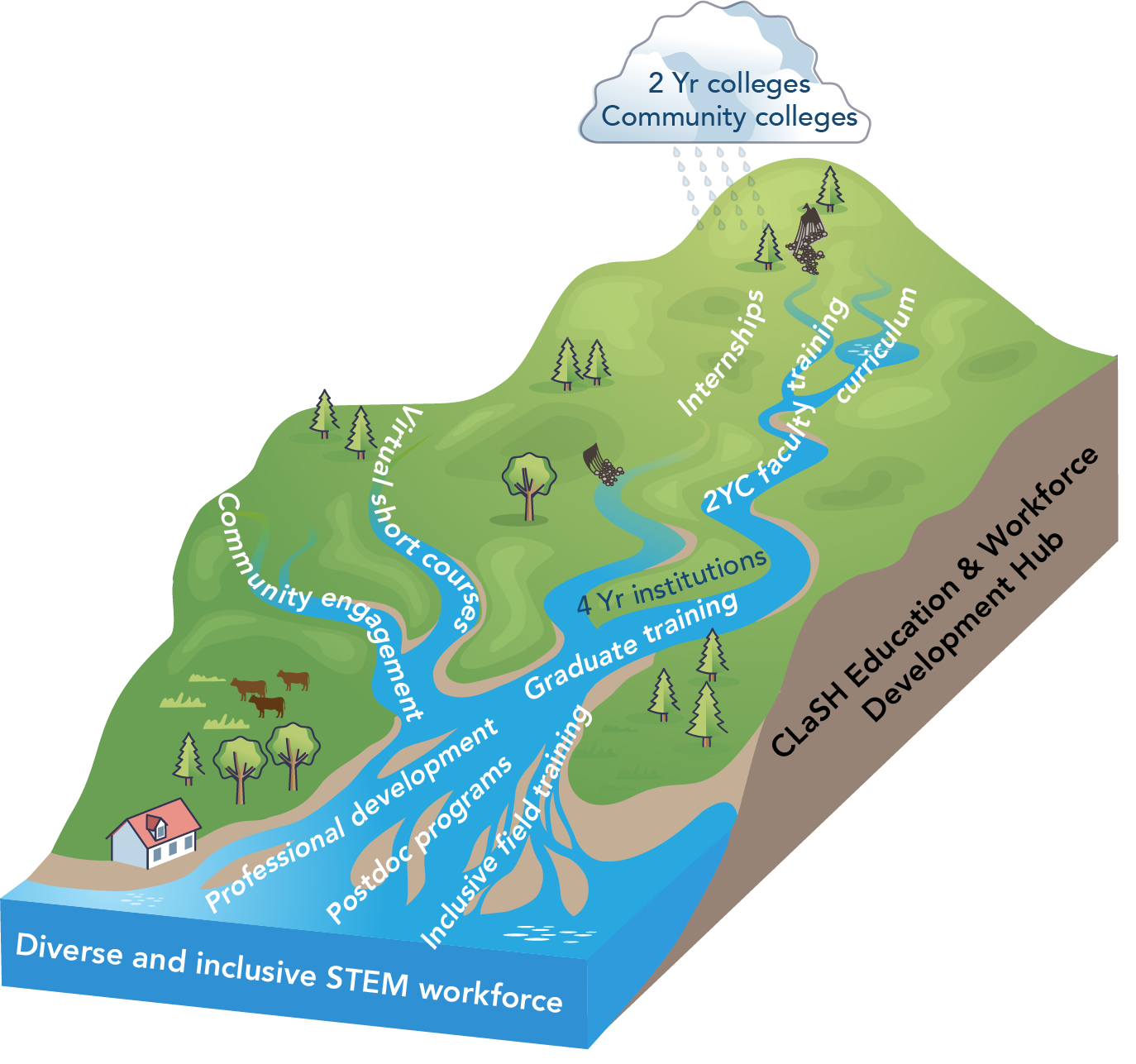 Transformative breakthroughs in understanding the land surface hazard cascade and in building societal resilience demand a technically capable, and adaptive workforce. By providing a suite of training and research activities that engage learners across a broad range of backgrounds and institutions, CLaSH prepares and inspires the next generation of researchers and practitioners working on land surface hazards.
The training and engagement of early career researchers in land surface hazards is limited in the U.S. We lack specific geoscience degree programs focused on natural hazards, and the interdisciplinary nature of the sub-discipline often leads to the dispersion of expertise across multiple departments in a research institution. CLaSH trains the next generation of geohazard scientists through inclusive field schools, workshops, and research opportunities that emphasize computational skills, and responsible engagement.
A notable observation from many large geoscience programs in the U.S. is that a disproportionate number of students who discover geoscience are transfer students who began their studies at 2YCs, community colleges, and satellite campuses of larger state university systems. 2YC faculty and instructors play a substantial role in retaining students in geosciences and shaping the geoscience workforce, making them effective partners to broaden the participation of 2YC students in the field. CLaSH is building partnerships with 2YC faculty and instructors at institutions proximal to the Hazard Observatories to co-develop curriculum modules and training exercises and offer faculty professional development workshops that will bring field- and data-based training focused on hazard cascade science into the introductory classes. CLaSH supports 2YC students directly through internships that offer research experiences in partnership with CLaSH teams and opportunities for disaster preparedness.