CLaSH Small Grant Program
The CLaSH Small Grant Program is open to the wider community and aims to provide flexible, seed-level funding to:
- support creative, high-risk/high-reward projects that broaden community participation by bringing new investigators and new expertise into the Center;
- advance understanding of interacting land-surface hazards, complementing the scope of current Center activities;
- foster cross-cutting science that connects observations, modeling, and societal relevance;
- open the door to new approaches to land surface hazard cascade research, via pilot studies that may grow into larger collaborative projects, development of new field sites, and application of novel modeling frameworks; and
- contribute to the Center’s goals of education, workforce development, and community engagement.
2026-2027 Priority Areas: In this year’s small grants program, we will prioritize the following research areas, but welcome all proposals that advance hazard cascade science, along with aligned community engagement and workforce development activities:
- Cross-observatory inquiry and modeling to test hypotheses about the geohazard cascade: We encourage site-specific investigations at CLaSH’s current Hazard Observatories located in Alaska, Appalachia, Puerto Rico, and Southern California, including proposals that:
- Apply geophysical, geochemical, or remote-sensing approaches,
- Integrate new tools and datasets across CLaSH Hazard Observatories, and/or
- Extend ongoing or post-event data collection in fire, landslide, or flood-impacted sites.
This year, we seek proposals that promote cross-observatory hypothesis testing with existing or new data, or proposals that focus on observatory work in Puerto Rico or Alaska. Within this scope, we encourage proposals that include partner engagement and community engaged research.
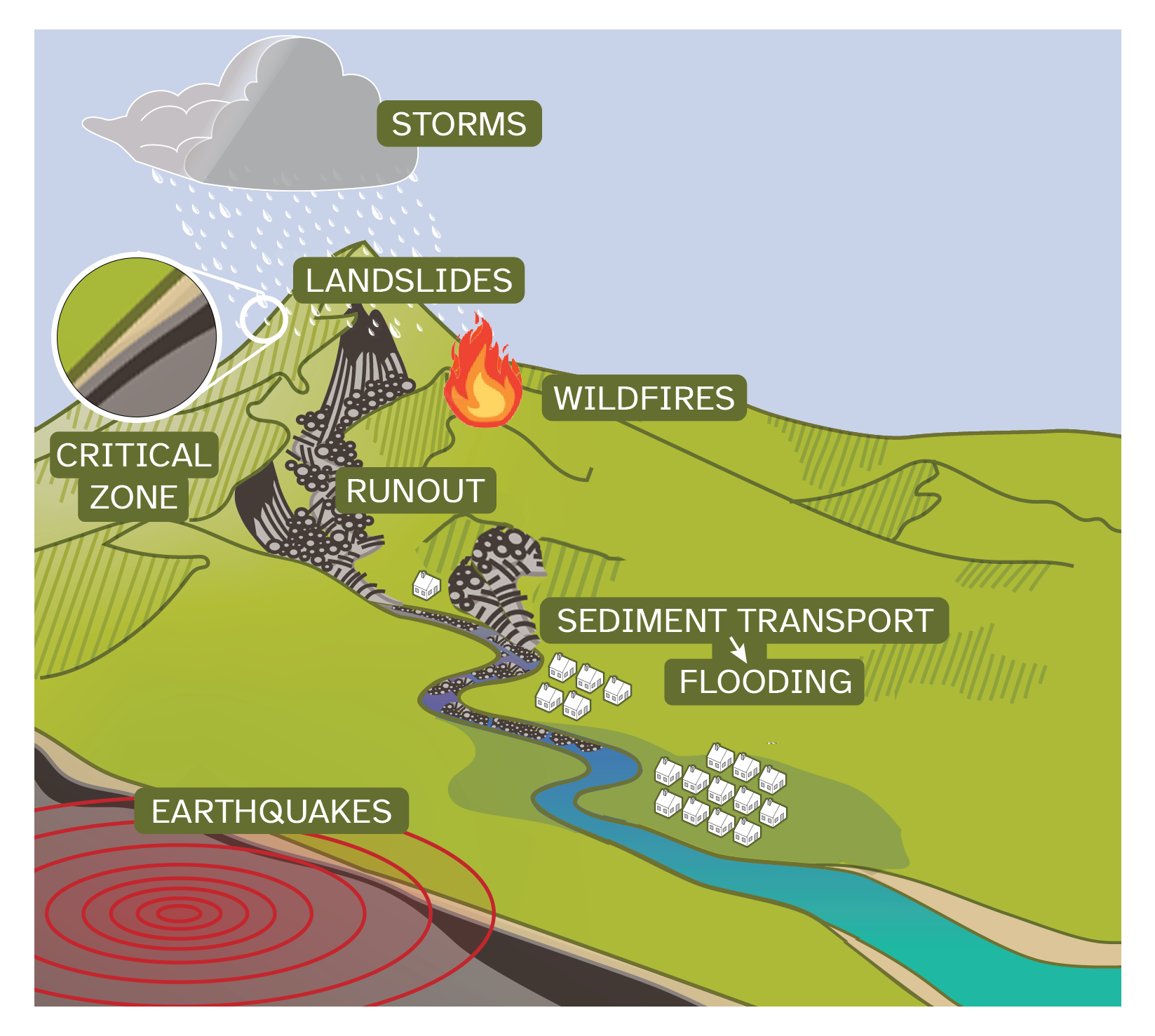
- Connecting the geohazard cascade through modeling: We solicit proposals that expand our ability to model cascades or link models addressing hazard components. Proposals could focus on triggers (i.e. weather or seismic forcing) or coupled hillslope-channel processes that lead to runout, sediment transport, and flooding. We encourage model-focused proposals that can work with the CLaSH Modeling Collaboratory and integrate their work into CSDMS frameworks (e.g. BMI, pyMT, Landlab). Development of ML/AI applications to cascade hazard modeling are especially welcome.
- Remote sensing products and AI that advance process understanding of land surface hazards at scale: To extend land surface hazard science from CLaSH observatories to regional and global scales, we encourage proposals that:
- Apply radar/InSAR and other remote-sensing approaches in novel ways to detect, map, and monitor hazard processes,
- Scale observatory-based measurements and models to regional or global products, and/or
- Build FAIR-compliant, AI-ready datasets, benchmarks, and AI methods for hazard detection and forecasting.
- Proposals directed in this priority area should explicitly describe how they contribute to the scientific goals of the CLaSH strategic plan.
- Event-driven investigations & new hazard types: We encourage proposals that enhance post-event science and build on the recent hazard response activities initiated through CLaSH (see the center event response page for more information). Proposals in this area could include, but are not limited to, development of workflows for data ingestion that enable rapid modeling of event response and cascade prediction as well as new tools for identifying or quantifying triggering processes and their precursors. Proposals focused on geographies outside of the current foci of CLaSH should clarify how the proposed work addresses elements of the strategic plan not addressed by current CLaSH geographies. Proposals focusing on hazards not included in ongoing CLaSH research should contextualize how the process of interest fits into a hazard cascade or the long tail of site response.
Several NSF facilities and other centers provide complementary resources that may be leveraged in proposals. Existing CLaSH partnerships include EarthScope, NHERI RAPID, DesignSafe, and OpenTopography. Proposers are also welcome to include other partners.
Key Dates
RFP Released: October 30, 2026
Application Submission Portal Opens: November 15, 2026
Proposal Deadline: January 15, 2027 (11:59 PM PST)
Award Notifications by: early- to mid-April 2027
Project Start: May 1, 2027
Project End: April 30, 2028
Final Report Due: May 30, 2028
Contact
Program Contact: contact@geoclash.org